The Biggest Myth About Card Payments: Visa & Mastercard Aren't Taking Most of Your Money
Careers
Banking & FinTech Jobs, curated daily
Open roles across banks, NBFCs, and fintechs - filter by category, experience, and salary.
2 Minute Summary
Many believe that Visa and Mastercard take the lion's share of the fees whenever a credit card is swiped. However, the truth is far more nuanced. This article explores how Merchant Discount Rates are divided among various players in the payment ecosystem, explaining the roles of banks, payment gateways, and card networks. Understanding these dynamics reveals that the actual share taken by Visa and Mastercard is quite small, as most of the fees are retained by issuing banks and other payment facilitators.
The moment you swipe your credit card at a shop or pay through an app, a notion often trickles down, claiming that companies like Visa and Mastercard are siphoning off all your hard-earned cash. This common perception is so deeply rooted that it’s often taken as gospel. However, unpacking the ins and outs of card payments reveals a different narrative—one where Visa and Mastercard hardly make a killing.
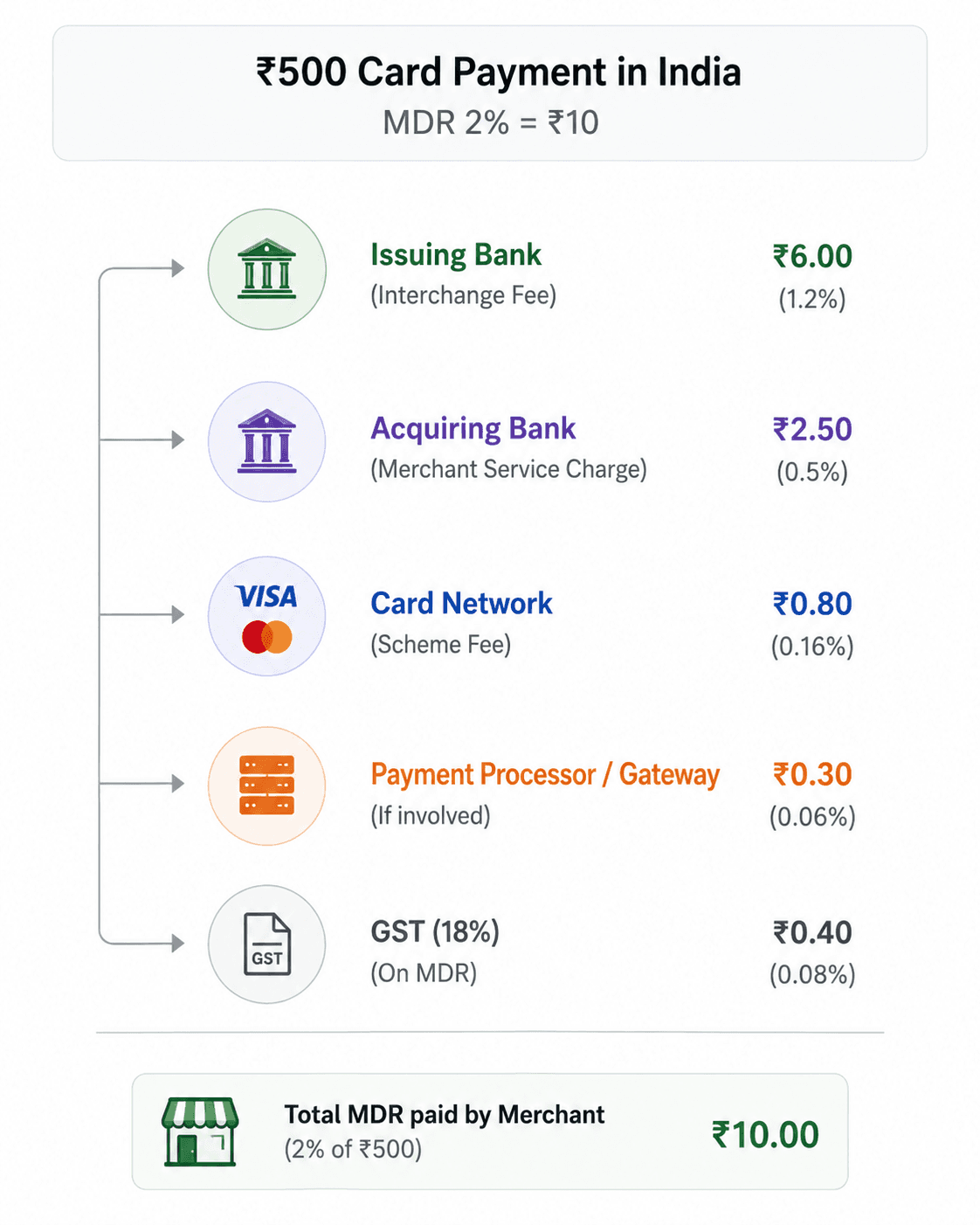
To grasp the reality, let's first introduce the concept of Merchant Discount Rate (MDR). MDR is the fee that merchants pay to accept card payments, primarily consisting of several components that benefit various players in the payments ecosystem. Imagine you buy that snazzy pair of shoes for ₹500, and your friendly neighborhood store gets dinged with a 2% MDR. That puts ₹10 in fees on the table, but here’s the kicker: that ₹10 doesn’t just vanish into a black hole.
In a typical transaction, several key players participate: take the merchant (the store), the customer (you), the acquiring bank (which manages the merchant's account), the issuing bank (your card's bank), card networks like Visa or Mastercard, payment gateways/processors, and, of course, the RBI, which regulates the payments system. Now, when that ₹10 fee gets broken down, it’s essentially distributed among these players instead of being gobbled up by Visa or Mastercard alone.
If you were to trace the flow of funds from that ₹500 transaction, here’s a simplified breakdown: from the ₹10 MDR, the issuing bank may take home anywhere around ₹5, while the acquiring bank could see ₹2, payment gateways might snag ₹1, and card networks like Visa/Mastercard get about ₹1 too, with the remaining relevant taxes applying. What a twist! It turns out most of the MDR actually is retained by banks, particularly the issuing bank, which is tasked with several costs. These include lending out money (credit), dealing with risks like fraud and defaults, offering rewards and cashback, and maintaining operational expenditures.
It’s important to understand the different kinds of fees involved—swap fees, network fees, acquiring fees, gateway fees, and even GST all play a role too. Interchange fees (typically the largest cut of the pie) are set by the card networks and vary significantly depending on card type, merchant category, and the transaction channel (by a Terminal Point of Sale versus online).
The primary reason the issuing bank lords over the largest share of the MDR is grounded in the costs it bears. It has to maintain those reward programs and cashback offers that keep customers happy and returning, and it also assumes the brunt of the risk associated with credit. In essence, every time you swipe, your issuing bank stares at potential losses if you don’t pay on time. Think of it as your bank shelling out cash upfront at a bar, hoping you won't bail before settling your tab.
Now, what about Visa and Mastercard? Despite their overwhelming brand presence, they actually take a small network fee from each transaction. Their role is mainly about maintaining the infrastructure and protocol for secure transactions rather than pocketing big fees. While it might seem shocking, Visa and Mastercard are what you might call the ‘middlemen’—efficiency kings, ensuring everything runs smoothly between your bank and the merchant’s bank, but not the ones cashing in the most.
The landscape of card payments isn’t homogenous. MDR rates can fluctuate dramatically, based on merchant type (retail, e-commerce, etc.), transaction channel (in-person versus online), and even specific agreements made between banks and merchants. This variability means that there’s no one-size-fits-all answer to how much of your transaction fee gets pocketed by each participant in the payment ecosystem. In fact, if you pay through UPI (Unified Payments Interface) instead, you operate on an entirely different set of fee dynamics, which are often lower but come with convenience that has disrupted traditional card payments in the Indian market.
Common misconceptions abound on social media—a popular claim is that banks pocket an astonishing 90% of fees. The truth? More nuance than drama. Visa and Mastercard certainly don’t take ‘everything’; in fact, much of the MDR flows to banks and other intermediaries. Understanding these players and their roles lays bare how payments actually work, stripping the mythic narrative that skews public perception.
Regulation by the RBI plays a crucial role too, ensuring there’s fair play within the ecosystem. With oversight on interchange fees and capping limits on MDR for certain merchant categories, the aim is to protect both merchants and consumers alike.
Why It Matters
Understanding the real dynamics of card payment fees uncovers the complexity of the payment ecosystem in India, making it essential for both merchants and consumers to know where their money goes and why certain fees exist. This knowledge can lead to better financial decisions and strategies, promoting transparency in banking and payment practices.
Who Benefits
Consumers benefit from a clearer understanding of where payment fees go, empowering them to make informed choices about spending. Merchants get insights on transaction costs, helping negotiate better terms with banks and payment processors. Overall, better-informed participants can drive competition and reduce fees across the payments landscape.
Who Is Impacted
Merchant businesses and customers are primarily impacted by the understanding of card payment fees. The more they grasp the fee structure and who earns from it, the more they can navigate payment processes wisely, enhancing their financial strategies and platforms.
Key Takeaways
- ✓MDR isn’t just pocketed by Visa and Mastercard; it's distributed among multiple players in the payment ecosystem.
- ✓The issuing bank usually takes the largest share of the MDR due to its funding and operation costs.
- ✓Different transaction types (online vs. in-person) and card categories affect fee structures significantly.
- ✓Popular misconceptions around fees often overlook the roles of various stakeholders in the payments ecosystem, including regulatory impacts from the RBI.